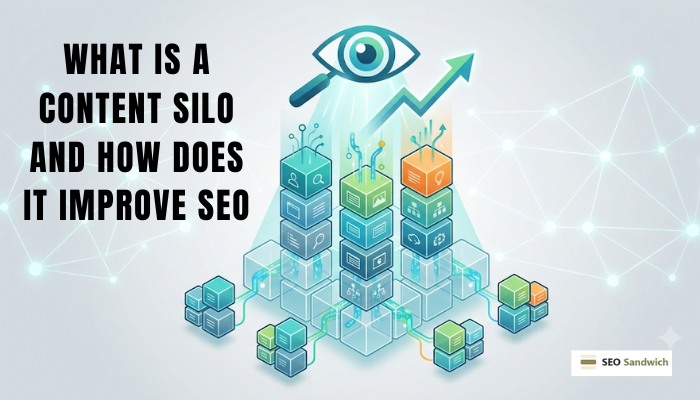
If your website covers ten different topics with no real connection between them, search engines have a hard time figuring out what your site actually stands for. Content silo for SEO solve this by organising pages by topic so search engines can read exactly what your site covers.
And yet, most site owners focus on publishing content without thinking about structure. Then they wonder why their pages compete against each other instead of working together to build topical authority.
At SEO Sandwich, we see this consistently across sites of every size. The fix starts with understanding how a solid content structure works, and that’s exactly what this article covers.
What Is a Content Silo in SEO?
A content silo is a structured grouping of related pages that helps Google understand your site’s topical focus. Every page inside a silo covers a different angle of the same subject, and internal links tie them all together into one unified topic cluster.
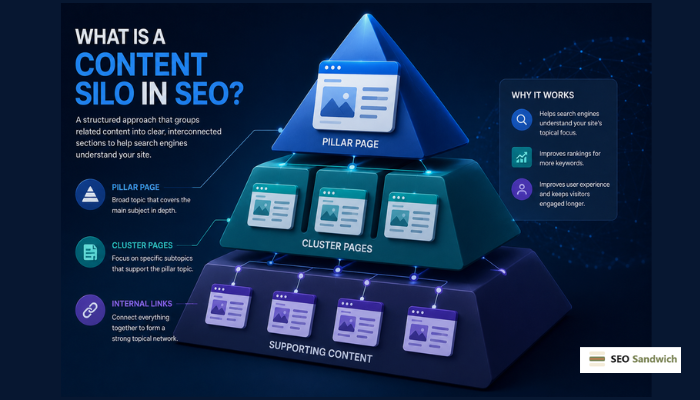
Without that framework, your site is basically a pile of individual URLs with no clear relationship between them (not ideal if you’re trying to rank in competitive search results). Site visitors also struggle to find related content, which pushes them off your site quickly.
Picture a content silo like a pyramid. Pillar pages sit at the top, covering the broad topic your site wants to rank for (say, “SEO strategy” for a digital marketing site). Cluster pages form the middle layer, each going deeper on a specific angle of that same theme. Finally, links between every level hold the whole site architecture together.
That pyramid only holds up when search engines can read why those articles belong together.
Why Google’s Search Results Reward Topical Structure
Basically, topical layout tells Google your site covers a subject deeply enough to rank above competitors who only scratch the surface. It does this by giving each page a defined role within a broader topical framework.

Two things make that possible more than anything else.
1. Organising Around a Core Topic
A core topic is the central theme your entire silo is built around, with every supporting page referencing it directly. Google uses it as the reference point for assessing how deep your coverage actually goes.
Topic-based keyword research is where the process begins. To find what your audience searches for, start by mapping out the queries they type into Google. From there, keyword difficulty and monthly searches will tell you which supporting angles are worth tackling first.
What we’ve found across every content plan we’ve built is that depth on that single subject beats breadth across ten. You can see it in the search results almost all the time.
2. Where Internal Links and External Links Come In
Both internal and external links work together to strengthen how Google reads your silo as a whole.
Internal links pass authority between pages inside the silo, and search engine crawlers follow those paths to map your entire internal linking framework. This gives Google a clear map of how your content fits together.
On the flip side, external links from other websites act as a vote of confidence for your silo. The more referring domains pointing to your pages, the stronger that trust indicator gets. That said, earning references from other sites takes time, but the results show up in your organic traffic.
Now that the structural side makes sense, one distinction needs addressing before you start planning your first silo.
Content Cluster or Content Silo: What’s the Difference?
Most SEO professionals use these two terms constantly, but they don’t mean the same thing.
A content cluster groups topic-related articles around a pillar page. It’s more of a broad overview, loosely connecting related URLs without that same level of site-wide separation. While it gives you flexibility, the algorithm has a harder time establishing a defined topical read from it.
In contrast, a content silo takes a stricter approach and separates your entire site into defined sections by theme. That means Google treats every section as its own topical territory.
For example, a fitness site using silos would keep ‘nutrition’ and ‘training’ completely separate. Each sits under its own pillar page, with dedicated cluster articles covering the finer details beneath it.
Choosing between the two is a fine line, and the team at SEO Sandwich helps clients draw it when building a content strategy from scratch.
Worth Noting: If your site covers multiple industries, silos give Google a reason to rank each one separately, instead of treating your whole domain as one confusing mix.
Build Topical Authority With a Solid Content Plan
A well-built content plan is the difference between a site that ranks across multiple keywords and one that plateaus on a single page. So here’s how to build one that holds up, starting with what you already have.
Auditing Your Existing Content
When you audit your existing content, you find which articles already cluster naturally and which ones have no connection to anything else on your site. At SEO Sandwich, nine times out of ten, the sites we work with have published great content but have no layout pulling it together. Those weak spots in your site structure hold otherwise good sites back from ranking higher.
Once you know which pages belong together, you still need to find exactly what’s missing. A content gap analysis will reveal which relevant topics your competitors cover that you don’t.
Google Search Console (GSC) helps here too. It flags URLs with impressions but little organic traffic and points to keyword gaps worth addressing next. Technical SEO issues like broken links also surface during this process, so fix those straight away.
Believe it or not, reorganising existing URLs into silos first is faster and cheaper than building a publishing push from zero.
How to Keep Content Fresh Using Google Search Console
In GSC, you can see which silo articles are losing impressions and need updating before rankings slip. Over time, outdated information on your blog posts pulls your whole silo’s topical depth down, and fresher pages on the same subject will outrank yours.
A quarterly review schedule protects your organic visibility long-term. During each check, you should action these four things:
- Update stats if the source has published newer figures
- Hunt down any broken links that appeared since the last review
- Check that every article in the silo still points to your pillar page
- Look for new keyword gaps that have opened up in your niche
That kind of upkeep tells the algorithm your site is a reliable source deserving of higher rankings.
Content Silos and AI Search Visibility: Does It Still Apply?
Sites with clear content silos are far more likely to appear in AI-generated search summaries than those with scattered, unorganised pages.
This happens because AI search results don’t just pull from high-quality content. They also favour sites that have demonstrated E-E-A-T (stands for experience, expertise, authoritativeness, and trustworthiness) across a whole subject area. That’s exactly what a well-built silo does.
In reality, gaining visibility in AI-generated answers comes down to topical depth rather than volume. So naturally, a site publishing 50 loosely related blog posts will lose out to a site with 15 tightly structured pages that cover one subject completely. And sites lacking that focus will drop further down, or disappear from those results entirely.
Fortunately, your silo strategy doesn’t need an overhaul to stay relevant. The same setup that built your authority in traditional search will push your rankings forward into AI-generated answers too (just remember to take one step at a time).
Start Building Your Silo Today
Honestly, content silos aren’t a complicated concept. They’re just a more organised approach to what you publish so Google, and your readers, can follow the thread from one page to the next.
Now, where do you start? Begin with an audit of your existing pages, map out which URLs share a topical thread, and build outward from your strongest subject area. These steps separate sites that rank consistently from those that don’t.
Our team at SEO Sandwich helps brands do exactly this through our productised content writing service. We match your target audience with high-quality blog posts that slot into a silo structure from day one.
If your site isn’t gaining the organic traction it deserves, let’s fix that.